Get In Touch
- Phone 01626479559
- Email hi.revox@gmail.com
- Address Based on honululu city, USA
- Follow us


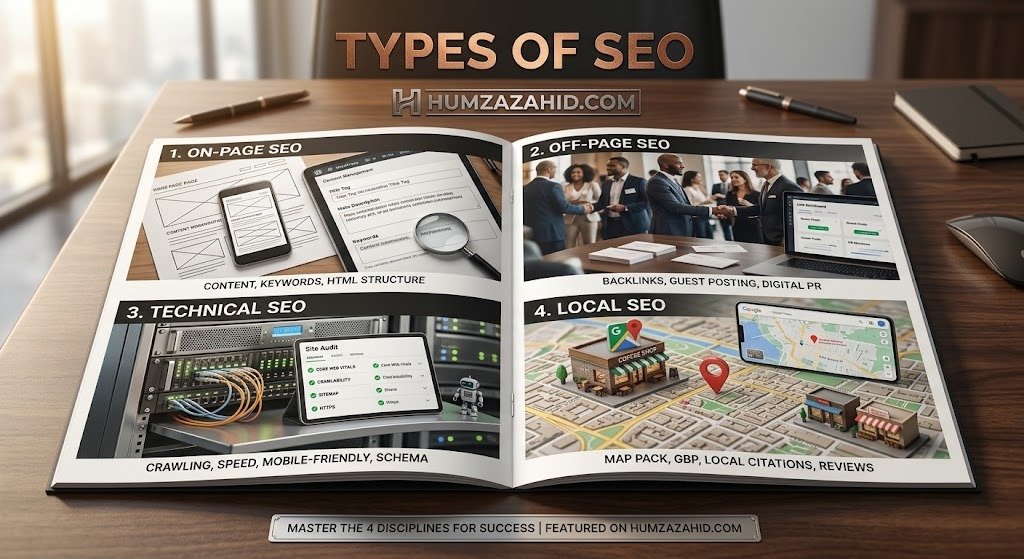
Types of SEO: How On-Page, Off-Page, Technical & Local SEO Work
Search engine optimization is not one single task. It is a set of four distinct disciplines that work together to get a website ranking in the search engine results page (SERP): on page SEO, off page SEO, technical SEO, and local SEO. Around 590 people search for “types of seo” every month, and most guides answer the question in a way that is either too shallow or too long to actually use. This one covers all four types in plain terms, with the real ranking factors and numbers behind each one.
The 4 Types of SEO at a Glance
Every SEO strategy, no matter the industry, is built from these four types. Some businesses need all four. A local service business, for example, cannot skip local SEO even with strong on page content.
1. On Page SEO
On page SEO covers everything you control directly on a page: the title tag, meta description, H1 and header tags, URL slug, keyword placement, internal linking, anchor text, alt text, and content optimization. It is the foundation, because a page with no on page structure gives Google nothing to match against a search query.
Core on page elements include:
● Title tag and meta description written for both keyword relevance and click through rate
● One clear H1, with H2 and H3 header tags structuring the content logically
● A short, descriptive URL slug instead of a long auto generated one
● Keyword density that reads naturally, not stuffed
● Internal links with descriptive anchor text pointing to related pages
● Image alt text and compression for both accessibility and page speed
● A canonical tag on every page to prevent duplicate content issues
Readability also falls under on-page SEO. Short paragraphs, clear headings, and content that actually answers search intent keep visitors on the page, which supports rankings indirectly through lower bounce rate and better dwell time.
2. Off Page SEO
Off page SEO covers everything that builds authority and trust for your site from outside its own pages. The biggest factor here is the backlink, a link from another site pointing to yours. Not all backlinks carry equal weight; a do follow link from a high domain authority site passes far more value than a no follow link from a low authority one.
Off page SEO activities include:
● Earning backlinks from referring domains with strong domain authority and domain rating
● Guest posting on relevant, reputable sites in your industry
● Digital PR to earn coverage and links from news and industry publications
● HARO style outreach connecting journalists with expert sources
● Broken link building, replacing dead links on other sites with a link to your content
● Monitoring anchor text distribution so it looks natural, not manipulated
● Disavowing toxic links that could trigger a manual action or algorithmic penalty
Link velocity, the rate at which new backlinks appear, also matters. A sudden, unnatural spike in links looks manipulative to Google’s algorithm, while a steady pace looks like organic growth.
3. Technical SEO
Technical SEO makes sure a site can actually be crawled, indexed, and ranked in the first place. A site can have excellent content and strong backlinks and still fail to rank if Googlebot cannot crawl it properly or if the page is too slow to pass Core Web Vitals.
Key technical SEO factors:
● XML sitemap and robots.txt configured correctly so crawlers find and index the right pages
● Clean site architecture with a logical URL and folder structure
● Core Web Vitals: LCP (loading speed), CLS (visual stability), and INP (responsiveness)
● Mobile first indexing, since Google primarily uses the mobile version of a site for ranking
● Schema markup and structured data to help search engines understand page content
● 301 redirects set up correctly during migrations to preserve ranking equity
● HTTPS as a baseline trust and security signal
● Crawl budget management so search engines spend their crawl time on your important pages, not on index bloat from thin or duplicate URLs
On sites with JavaScript heavy frameworks, JavaScript rendering is a specific technical concern. If Google cannot render the JavaScript properly, it may not see the content at all, no matter how well optimized that content is.
4. Local SEO
Local SEO targets the Google Map Pack and local pack, the results shown when someone searches with a city name or “near me.” This is a separate discipline because Google uses a different set of ranking signals for these searches: proximity, relevance, and prominence, rather than the pure content and backlink signals used for standard organic results.
Local SEO ranking factors include:
● A fully optimized Google Business Profile (GBP), including categories, services, and posts
● NAP consistency, meaning your Name, Address, and Phone number match exactly across your website and every local directory
● Citations from local and industry directories
● Review quantity, quality, and recency, supported by review schema on the website
● Geo targeting for service area businesses that serve a region rather than a single storefront
● Localized landing pages built for each city or service area, rather than one generic locations page
Local SEO matters even for businesses that already rank well organically, because the Map Pack sits above organic results for location based searches and captures a large share of clicks before a searcher even scrolls to the blue links.
Types of Keywords in SEO
Around 90 people a month search specifically for “types of keywords in seo,” so it is worth covering alongside the four types of SEO above, since keyword research feeds into all of them.
| Keyword type | What it means | Example |
| Short tail keywords | Broad, one or two word searches with high volume and high competition | “seo” |
| Long tail keywords | Longer, specific phrases with lower volume but higher buyer intent | “local seo services in lahore” |
| Informational keywords | Searches looking for an answer or explanation, not a purchase | “what is seo” |
| Commercial keywords | Searches comparing options before a decision | “best seo agency” |
| Transactional keywords | Searches with clear buying intent | “hire seo expert” |
| Navigational keywords | Searches for a specific brand or website | “semrush login” |
Search intent for each keyword type also varies, and matching content format to intent (a comparison page for commercial intent, a how to guide for informational intent) is what turns rankings into clicks and conversions rather than just impressions.
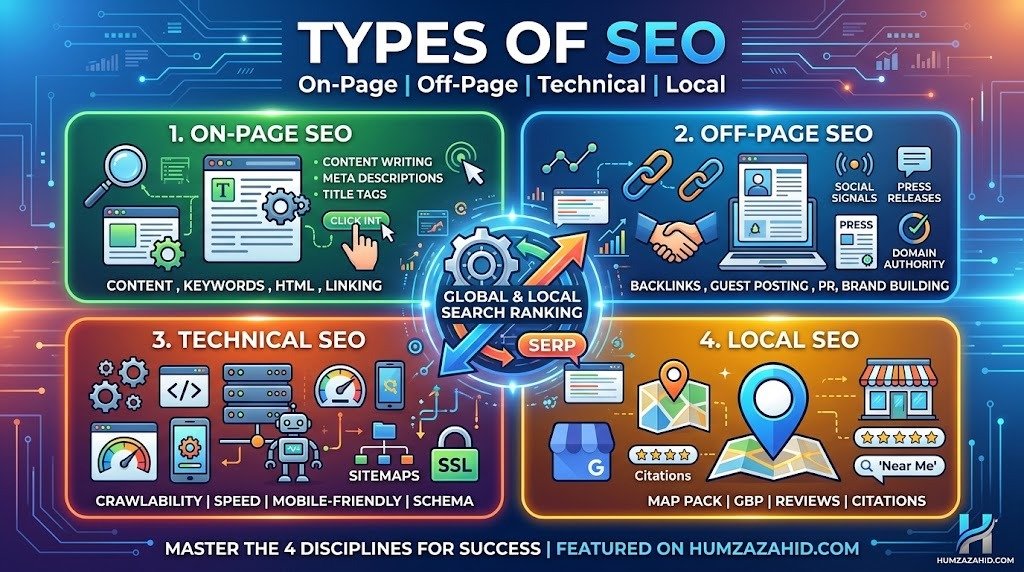
How the 4 Types of SEO Work Together
None of these four types work well in isolation. Technical SEO makes a site crawlable, on page SEO gives search engines relevant content to match against a query, off page SEO builds the authority needed to outrank competitors, and local SEO captures the map pack for anyone searching with local intent. A ranking factor comparison makes the relationship clearer:
| SEO type | Main goal | Key ranking signals |
| On page | Relevance to a search query | Titles, headers, content, internal links |
| Off page | Authority and trust | Backlinks, referring domains, digital PR |
| Technical | Crawlability and indexability | Site speed, Core Web Vitals, schema, sitemap |
| Local | Map Pack and local pack visibility | Google Business Profile, NAP, citations, reviews |
Frequently Asked Questions
How many types of SEO are there?
There are 4 main types of SEO: on page, off page, technical, and local. Some breakdowns split these further, but nearly every SEO task falls under one of these four categories.
Which type of SEO is most important?
None of the four works well alone. Technical SEO has to be correct for a site to be indexed at all, but a technically sound site with no on page optimization or backlinks still will not rank for competitive terms.
Is local SEO different from regular SEO?
Yes. Local SEO targets the Google Map Pack using proximity, relevance, and prominence signals, including Google Business Profile and NAP consistency, while regular SEO targets standard organic rankings.
Do I need all 4 types of SEO for my website?
Most businesses need on page and technical SEO at minimum, since these affect whether a site is crawlable and relevant at all. Off page SEO becomes necessary in competitive niches, and local SEO is essential for any business serving a specific city or area.