Get In Touch
- Phone 01626479559
- Email hi.revox@gmail.com
- Address Based on honululu city, USA
- Follow us


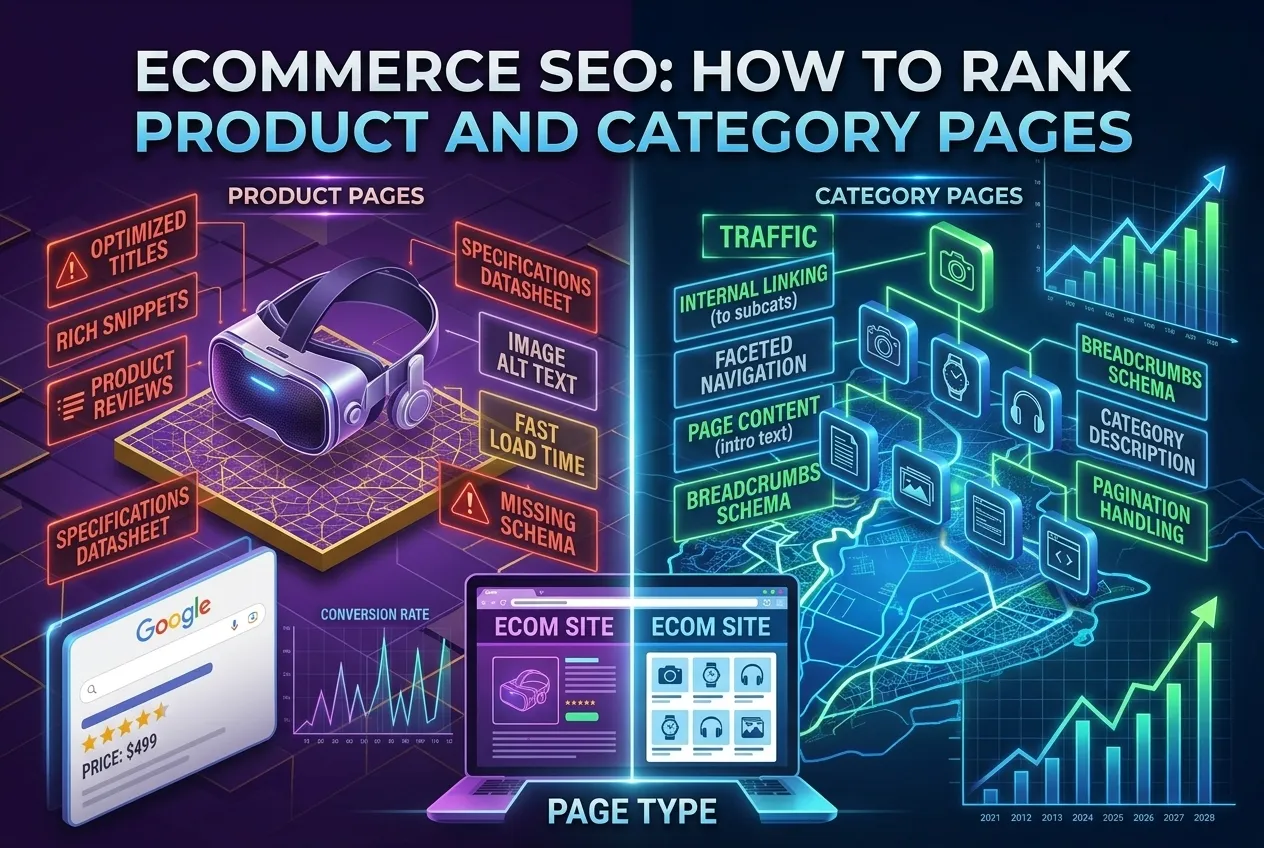
Ecommerce SEO: How to Rank Product and Category Pages
A practical, data-backed framework for product page SEO, category page SEO and technical ecommerce SEO, built for store owners who want rankings that turn into revenue.
Learning how to do SEO of an ecommerce website comes down to one question: can Google crawl, understand and trust every product and category page you sell from? Ecommerce SEO is the practice of optimising an online store’s category pages, product pages, site architecture and technical foundations so they earn organic traffic from shoppers who are ready to buy.
It matters because organic search is still one of the biggest acquisition channels in online retail. Similarweb’s 2025 benchmark puts organic search at 23.56% of ecommerce website traffic, and non-branded organic keeps delivering scale even as AI shopping tools grow. But the rules have shifted: AI Overviews now appear on roughly 14% of shopping queries, and rankings alone no longer guarantee clicks.
This guide walks through the full process, from how Google reads your store to how to structure categories, write product pages that convert, fix technical problems and measure results. If you would rather have specialists do it, our Ecommerce SEO Services team handles all of it for Shopify, WooCommerce and Magento stores.
| Key takeaways Category pages drive the most valuable rankings. They target broad commercial terms; product pages capture specific, high-intent ones. Technical health is a revenue lever. Only about 39% of ecommerce sites pass all three Core Web Vitals (HTTP Archive, 2025), so passing is a real competitive edge. Structured data feeds both Google and AI answers. Correct Product and Offer markup makes pages eligible for merchant listings and rich results. Measure revenue, not just rankings. Track organic revenue, conversion rate and cost per acquisition against paid search. |
Why Ecommerce SEO Is Different From Regular SEO
A blog has dozens of pages. A store can have tens of thousands, generated by templates, filters, variants and pagination. That scale creates problems ordinary SEO never faces: duplicate content, index bloat, wasted crawl budget and thin pages that Google would rather ignore.
Search intent is different too. People searching a product term want to compare options, check price and availability, read reviews and buy. Google rewards pages that satisfy that transactional and commercial intent, which is why ecommerce SEO leans so heavily on structured data, trust signals and page experience.
The current search landscape: what the data shows
| Metric | Figure | Why it matters for your store |
| Organic share of ecommerce traffic | 23.56% (Similarweb 2025 benchmark) | Organic remains a top-tier acquisition channel. |
| AI Overviews on shopping queries | About 14% (Visibility Labs, March 2026) | Ranking is not enough; structured, citable content wins visibility. |
| Organic CTR with an AI Overview | 0.61% vs 1.62% without (cited by ALM Corp) | Fewer clicks per impression makes conversion rate more important. |
| AI referral traffic growth | +393% YoY, US retail, Q1 2026 (Adobe) | A small but fast-growing discovery channel to prepare for. |
| Ecommerce sites passing all Core Web Vitals | About 39% (HTTP Archive, 2025) | Most competitors are failing, so speed is an opening. |
Figures come from third-party studies and vendor research, cited with their publication dates. Treat AI-related numbers as directional, since measurement methods differ between studies.
Step 1: Build Ecommerce Keyword Research Around Buyer Intent
Keyword research for a store is about mapping the right term to the right page type. Get this wrong and category and product pages end up competing against each other, a problem known as keyword cannibalisation.
| Page type | Target keyword pattern | Example |
| Homepage | Brand and broad category terms | your brand + main product line |
| Category page | Broad commercial terms, plural | running shoes, leather sofas |
| Subcategory / facet | Category + attribute (size, colour, brand) | black running shoes for women |
| Product page | Exact model, SKU and long-tail terms | Brand X Model 200 trail runner |
| Blog / guide | Informational and comparison queries | how to choose running shoes |
One URL per intent. Assign each primary keyword to a single page, then support it with related terms and entities on that page. Use Google Keyword Planner, Semrush or Ahrefs to check search volume and keyword difficulty, and Google Search Console to see which queries already trigger impressions. Look for high-volume category terms and low-difficulty long-tail product terms, then prioritise by revenue potential rather than volume alone.
Step 2: Design a Flat Site Architecture and Clean URLs
Site architecture decides how link equity flows and how efficiently crawlers find your products. The aim is a flat structure where every product is reachable in as few clicks as possible, ideally three from the homepage.
Homepage > Category > Subcategory > Product
- Keep URL slugs short and readable: /mens-running-shoes/ beats /category?id=4471&sort=price.
- Do not put category paths in product URLs if products can sit in more than one category. That creates duplicate URLs for the same product.
- Use breadcrumb navigation with BreadcrumbList schema so users and crawlers understand hierarchy.
- Link from high-authority pages (homepage, top categories) to best sellers and new arrivals with descriptive anchor text.
Step 3: Optimise Category Pages to Rank
Category pages are usually your biggest ranking opportunity. They match broad commercial searches, concentrate internal link equity and can target hundreds of related terms. They are also where most stores under-invest, leaving a grid of products with no supporting content.
Category page SEO checklist
- Title tag: lead with the primary keyword, add a benefit, keep it near 60 characters. Example: Leather Sofas | Free Delivery and 30-Day Returns.
- H1: one per page, matching the primary keyword naturally.
- Intro copy above the fold: 50 to 150 words that describe the range and use the keyword and related entities. Keep it short so products stay visible.
- Supporting content below the grid: buying guidance, sizing help and FAQs that answer real questions, marked up with FAQPage schema where appropriate.
- Internal links: link to subcategories, top products and related guides using descriptive anchor text.
- Unique meta description: a benefit-led summary with a clear call to action to lift click-through rate.
| Category pages: get pagination right Google stopped using rel=next and rel=prev as an indexing signal in 2019, so you do not need them for Google. What matters now: Self-referencing canonical: page 2 canonicalises to page 2, never back to page 1, or products deeper in the series can be stranded. Crawlable links: pagination must use real anchor links in the server-rendered HTML, not JavaScript-only load-more buttons. Unique titles: append the page number to titles and descriptions so pages are distinguishable. |
Step 4: Optimise Product Pages for Search and Conversion
A product page has two jobs: rank for specific, high-intent queries and convince a visitor to buy. Manufacturer descriptions copied across dozens of retailers do neither. Google sees them as duplicate content, and shoppers see nothing that helps them decide.
On-page essentials for every product
- Unique descriptions: write original copy covering benefits, specifications, materials, dimensions, compatibility and use cases. Prioritise best sellers first.
- Title tag and H1: include the product name, key attribute and model. Avoid keyword stuffing.
- Images: compress to WebP or AVIF, write descriptive alt text, use descriptive file names, and never lazy-load the main hero image.
- Customer reviews: reviews add fresh, unique content and trust. Mark them up with AggregateRating only when they are real and visible on the page.
- Availability and price: show them in the visible HTML and keep them consistent with your markup and Merchant Center feed.
- Related products and internal links: link to complementary items and the parent category to pass relevance upward.
- Product FAQs and specs tables: answer pre-purchase questions and give AI systems clean facts to cite.
Handling variants, out-of-stock and discontinued products
Colour and size variants should usually share one canonical product URL unless a variant has real independent search demand. For out-of-stock items you plan to restock, keep the page live and show availability clearly. For permanently discontinued products, 301 redirect to the closest equivalent product or category, and return a 404 or 410 only where no relevant replacement exists.
Step 5: Implement Product Structured Data (Schema Markup)
Structured data is code that tells search engines exactly what a page contains. For stores, it is one of the highest-impact technical steps because it can make product pages eligible for richer search appearances, including price, availability, review ratings and shipping information.
Google distinguishes two classes of product markup. Product snippets are for pages where people cannot directly purchase, such as editorial reviews. Merchant listings are for pages where customers can buy from you, and they support more detail such as shipping, returns and variants.
| Schema type | Use it on | Key properties |
| Product + Offer | Every product page | name, image, description, sku, brand, offers (price, priceCurrency, availability, url) |
| AggregateRating / Review | Product pages with real reviews | ratingValue, reviewCount (must be visible on page) |
| BreadcrumbList | All product and category pages | itemListElement with position, name, item |
| MerchantReturnPolicy | Organisation or product level | Return window, method and fees, matching your policy page |
| FAQPage | Category pages and buying guides | Question and acceptedAnswer pairs |
| Organization | Sitewide | name, logo, url, sameAs profiles |
| Schema rules that prevent penalties and disapprovals Price format must be a plain number (19.99), never with symbols or thousands separators. Markup must match visible page content and your Merchant Center feed. Mismatched price or availability is a common cause of disapprovals. Google does not guarantee rich results, so treat schema as accurate metadata, not a ranking shortcut. Validate with the Rich Results Test and monitor the Merchant listings report in Google Search Console. |
Step 6: Fix Technical SEO for Ecommerce
Technical SEO for ecommerce is where large stores win or lose. Crawl budget, index bloat, faceted navigation and page speed all scale with catalogue size, and small mistakes multiply across thousands of URLs.
Faceted navigation and filters
Filters for colour, size, brand and price are great for shoppers but can generate near-infinite URL combinations. Google warns that crawling faceted URLs consumes large amounts of server resources and can delay discovery of new content. Its guidance is to decide which faceted URLs deserve to be indexed and prevent crawling of the rest.
- Index only facets with real search demand (for example, black running shoes) and give them clean, static URLs, a unique title and unique copy.
- Block crawling of low-value combinations such as sort orders, price sliders and multi-filter states, using robots.txt rules or by keeping them client-side.
- Use rel=canonical to consolidate filtered variants onto the main category. Google notes canonicals take time to be picked up and are less effective long term than preventing crawling.
- Return a 404 for empty result pages and keep filter order consistent so the same combination never produces two URLs.
- Include only canonical URLs in your XML sitemap.
Core Web Vitals and page speed
Core Web Vitals are Google’s real-user page experience metrics, measured at the 75th percentile of Chrome users over a rolling 28 days. INP replaced First Input Delay in March 2024, so any guidance still citing FID is out of date.
| Metric | Measures | Good | Poor |
| LCP (Largest Contentful Paint) | Loading speed | 2.5 seconds or less | Over 4 seconds |
| INP (Interaction to Next Paint) | Responsiveness | 200 ms or less | Over 500 ms |
| CLS (Cumulative Layout Shift) | Visual stability | 0.1 or less | Over 0.25 |
Speed is directly tied to revenue. A Google and Deloitte study found that a 0.1-second improvement in mobile site speed lifted retail conversions by 8.4% and average order value by 9.2%. Portent’s analysis of ecommerce sites found conversion rates fall by roughly 4.4% for each extra second of load time between 0 and 5 seconds. Case studies point the same way: Vodafone Italy saw 8% more sales after a 31% LCP improvement, and Rakuten 24 reported a 33% conversion lift after improving Core Web Vitals. These studies are correlational, so treat the exact percentages as indicative rather than guaranteed.
Fast wins for ecommerce speed
- Preload and prioritise the LCP image with fetchpriority=”high”, and never lazy-load it.
- Set explicit width and height on every image, video and ad slot to prevent layout shift.
- Compress images to WebP or AVIF and serve responsive sizes.
- Audit third-party scripts (chat widgets, review apps, trackers) and defer anything non-essential, since these are the usual cause of poor INP.
- Use a CDN and server-side rendering so product content is in the initial HTML.
JavaScript rendering, HTTPS and mobile-first indexing
Google indexes the mobile version of your site, so mobile content, structured data and internal links must match desktop. If product listings or prices load only after JavaScript runs, confirm they appear in the rendered HTML using the URL Inspection tool. Serve everything over HTTPS, keep your XML sitemap and robots.txt clean, and run a log file analysis on large catalogues to see where Googlebot actually spends its crawl budget.
Platform Notes: Shopify, WooCommerce and Magento
| Platform | Common SEO issue | What to do |
| Shopify | Duplicate product URLs under /collections/ and /products/; limited control over URL structure and robots.txt in some setups | Confirm product canonicals point to the /products/ URL, use collection filters carefully, and add schema through the theme or a vetted app. |
| WooCommerce | Bloat from plugins, slow hosting, and tag or attribute archives creating thin pages | Use a lean theme, quality hosting, an SEO plugin such as RankMath or Yoast, and noindex low-value archives. |
| Magento | Heavy JavaScript, large catalogues and layered navigation creating crawl waste | Optimise layered navigation rules, enable full-page caching and audit crawl budget with server logs. |
Step 7: Build Authority With Content and Links
Product and category pages rarely attract links on their own. Support them with content that earns citations and trust: buying guides, comparison posts, size charts, how-to content and original data. Link those guides to the relevant category and product pages with descriptive anchor text so equity flows to the pages that make money.
- Digital PR and unique data: publish original research or trend data that journalists cite, and pitch it through outlets and HARO-style requests.
- Supplier and brand links: ask manufacturers and partners for stockist and where-to-buy links.
- Broken link building: find dead resources in your niche and offer your content as a replacement.
- Monitor your backlink profile: watch referring domains and anchor text distribution, and disavow only genuinely toxic links.
Step 8: Prepare for AI Overviews and AI Shopping
Generative search is changing product discovery. Rankings are a weaker predictor of citation than they used to be: one analysis found overlap between top-10 organic results and AI Overview sources fell from around 75% in mid-2025 to between 17% and 38% in early 2026. AI systems appear to favour clear structure, direct answers and structured data alongside topical depth.
To be citable, make your pages easy to extract from:
- Answer buyer questions directly near the top of guides, then expand.
- Use complete, accurate Product, Offer, FAQPage and BreadcrumbList markup.
- Present specifications in clean tables and lists.
- Build topical authority with a cluster of connected guides around each product category.
- Keep price, stock and policies accurate and consistent across your site and Merchant Center feed.
The upside is real: several studies report that AI-referred visitors convert at higher rates than average organic visitors, and Search Console now offers dedicated generative-AI reporting for eligible properties. The practical response is to keep ranking, keep converting and make your content easy for AI systems to trust.
How to Measure Ecommerce SEO Success
Vanity metrics hide problems. Track the numbers that connect SEO to profit, and compare them with your paid search benchmark.
| KPI | Where to find it | What good looks like |
| Organic revenue and transactions | Google Analytics 4 | Steady month-on-month growth, segmented by landing page type |
| Non-branded impressions and clicks | Google Search Console | Rising impressions on category and product queries |
| Keyword rankings and share of voice | Semrush or Ahrefs | More category terms in the top 3 |
| Conversion rate by landing page | GA4 | Category and product pages converting above site average |
| Core Web Vitals pass rate | Search Console, PageSpeed Insights | 75% or more of visits rated Good on all three metrics |
| Indexed vs submitted pages | Search Console indexing report | Indexed count close to your canonical URL count |
| Cost per acquisition vs paid | GA4 plus ad platform data | Organic CPA trending below paid over 6 to 12 months |
Set a review rhythm at 30, 60 and 90 days. Ecommerce SEO is a compounding channel: technical fixes show up first, category and content gains follow over several months.
Common Ecommerce SEO Mistakes to Avoid
- Copying manufacturer descriptions across many products, creating duplicate content and zero differentiation.
- Letting filters and sort orders create indexable URLs, which bloats the index and wastes crawl budget.
- Canonicalising every paginated page to page 1, which can hide deeper products from Google.
- Marking up reviews that are not visible on the page, which breaks Google’s structured data guidelines.
- Deleting out-of-stock pages without redirects, throwing away links and rankings.
- Ignoring mobile and INP, when most shoppers browse on phones and INP is the most commonly failed Core Web Vital.
Ecommerce SEO FAQs
How long does ecommerce SEO take to show results?
Technical fixes and on-page improvements can show movement in weeks, but meaningful growth in category rankings and revenue usually takes three to six months, and longer in competitive niches.
Should I optimise category pages or product pages first?
Start with category pages. They target broader, higher-volume commercial terms and pass link equity to products. Then optimise best-selling product pages.
Does Shopify or WooCommerce rank better?
Neither ranks better by default. Both can rank well when configured correctly. Shopify is simpler to run but has structural quirks such as duplicate URLs; WooCommerce offers more control but needs disciplined hosting and plugin management.
Do I need product schema markup?
It is strongly recommended. Product and Offer markup makes pages eligible for merchant listings and rich results, and helps Google and AI systems read price, availability and reviews accurately. Google does not guarantee that rich results will appear.
How do I handle duplicate content from filters and variants?
Decide which faceted pages have search demand and index only those with clean URLs. Prevent crawling of low-value filter combinations and use canonical tags to consolidate the rest.
Are Core Web Vitals really a ranking factor?
Yes, as part of Google’s page experience signals, though content relevance and authority remain stronger. Treat them as a tiebreaker and a conversion lever, since speed also improves sales.
How do I appear in AI Overviews and AI shopping results?
Publish clear, direct answers, use complete structured data, keep product data accurate and build topical authority with connected guides. No tactic guarantees inclusion.
| Ready to turn your product and category pages into a revenue channel? Ecommerce SEO rewards stores that get the technical foundations and the content right together. Our team combines technical SEO, category and product page optimisation, structured data and AI-search readiness for Shopify, WooCommerce and Magento stores. What you get: a free SEO audit of your store, a prioritised 30/60/90-day action plan, transparent monthly reporting and no long-term lock-in contract. Next step: Get a Free SEO Audit of Your Website, or explore our Ecommerce SEO Services and Technical SEO Services. |