Get In Touch
- Phone 01626479559
- Email hi.revox@gmail.com
- Address Based on honululu city, USA
- Follow us

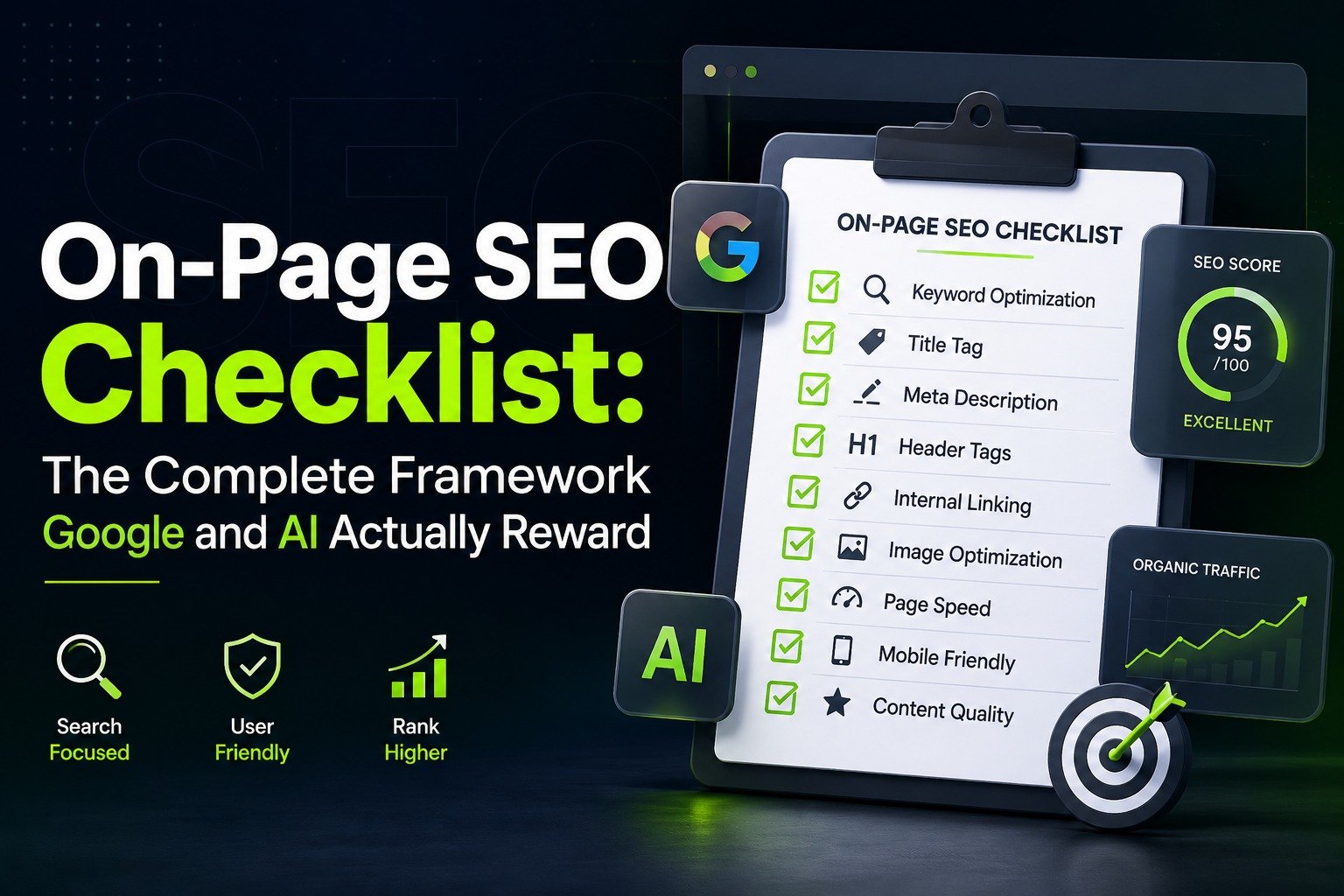
On-Page SEO Checklist: The Complete Framework Google and AI Actually Reward
Most on-page SEO checklists were written for a search engine that no longer exists in the way it once did. They tell you to stuff a keyword into your title, repeat it three times in the body, and add an alt tag, as if Google in 2026 were still matching strings the way it did in 2010. It is not. Google now reads a page the way a well informed person would: for what it actually says, who it is clearly for, and whether the facts hold up. On top of that, a growing share of your future readers will never open your page at all. They will ask ChatGPT, Google AI Overviews, or Perplexity a question, and one of these systems will read your page, extract what it needs, and hand your reader an answer with or without a click through.
That changes what on-page SEO actually means. It is no longer a checklist of things to insert into HTML. It is the discipline of writing a page that a machine reading system, human or AI, can quickly understand, trust, and quote. This guide walks through every layer of that: the classic technical basics that still matter, the entity and semantic layer that most checklists skip entirely, and the newer practice of structuring content so large language models can extract and cite it correctly. If you want a hands on service rather than a DIY checklist, our on-page SEO services team handles this end to end, but everything below is written so you can do it yourself if you would rather.
What Is On-Page SEO, Exactly?
On-page SEO is every change you make directly on a webpage, in its content and its HTML, to help search engines and AI systems understand what the page is about and to help the people who land on it get what they came for. It sits opposite off-page SEO, which covers signals that happen away from your site, such as backlinks and mentions. On-page SEO covers everything within your control on the page itself: the words, the structure, the code, the images, and the internal links.
The distinction matters because on-page work is the only category where you have full control. You cannot force another website to link to you, but you can control every heading tag, every sentence, and every piece of structured data on your own page today. That is exactly why it remains the highest leverage place to start any SEO effort, whether the audience reading the result is a person scrolling Google or a language model summarising your page in an answer.
Why On-Page SEO Looks Different in 2026
Three shifts have changed what a well optimised page looks like, and a checklist that ignores them is already out of date.
Search intent now matters more than keyword matching
Google’s ranking systems compare what a page delivers against what a searcher actually wants, not just whether the words match. A page can contain the exact keyword and still rank poorly because it answers the wrong question. Before writing a single sentence, look at what is currently ranking for your target term and ask what those pages have in common: are they comparisons, how-to guides, product pages, or definitions. Match that format first, then optimise within it.
Entities and topical depth carry more weight than keyword density
Modern search systems build an understanding of a page from the concepts, entities and relationships it contains, not from how many times one phrase repeats. A page about on-page SEO that never mentions title tags, header tags, internal linking, schema markup, canonical tags, or Core Web Vitals reads as thin to a system that expects those entities on a page claiming this topic, regardless of how well the target keyword itself is placed. Covering the full entity set is now a stronger signal than density ever was.
AI answer engines read pages differently than Google’s classic crawler
When ChatGPT, Perplexity, or Google’s AI Overview process a page, they are trying to extract a clean, quotable, standalone answer, usually to drop directly into a response. Pages that bury the answer inside long, meandering paragraphs are harder to extract from and get skipped in favour of pages that state the answer plainly near the top of a section, in a sentence or two that could be lifted out and still make complete sense on its own. This does not replace writing for people. It rewards writing that is direct.
The Complete On-Page SEO Checklist
Here is the full framework, broken into the layers that matter, in the order to actually work through them on a new or existing page.
1. Search intent and content format
• Search the target keyword yourself and note the dominant content format in the top results: guide, comparison, list, product page, or tool
• Identify the searcher’s underlying goal, not just the literal query, since many keywords hide a more specific need
• Match your page type to that intent before writing anything else, since no amount of on-page polish fixes the wrong format
2. Title tag
• Place the primary keyword naturally near the front of the title
• Keep it under roughly 60 characters so it does not get cut off in search results
• Write for a click, not just for a match, since the title is also your ad copy in the results page
• Make every title on the site unique, since duplicate titles confuse both crawlers and readers scanning results
3. Meta description
• Keep it under roughly 155 to 160 characters
• Summarise the specific benefit or answer on the page, not a generic pitch
• Include the primary keyword where it reads naturally, since Google sometimes bolds matching terms in results
• Remember this does not directly affect rankings, but a strong one lifts click-through rate, which is a meaningful downstream signal
4. URL slug
• Keep the URL short, lowercase, and hyphen separated
• Include the primary keyword once
• Avoid dates, stop words, and unnecessary parameters that add length without adding meaning
5. Heading structure (H1 through H4)
• Use exactly one H1 per page, matching the primary topic
• Structure H2s as the main sections and H3s as sub-points beneath them, in a logical hierarchy rather than skipping levels
• Write headings as questions or clear statements where relevant, since these are often what AI systems and featured snippets extract directly
• Include secondary and semantic keywords in H2s and H3s naturally, not just the exact primary term repeated
6. Content quality and depth
• Answer the core question directly within the first 100 to 150 words, before any lengthy preamble
• Cover the topic in genuine depth rather than padding a thin idea to hit a word count
• Back claims with specifics: numbers, examples, named tools, or named processes rather than vague statements
• Write short, extractable summary sentences under key headings so both readers and AI systems can quote a clean answer
• Update content when facts, tools, or figures change, since freshness is a real signal for time sensitive topics
7. Keyword usage and semantic coverage
• Include the primary keyword in the title, H1, first 100 words, and at least one H2
• Keep primary keyword density in the range of roughly 1.0 to 1.5 percent, treating this as a natural ceiling rather than a target to hit
• Cover the full set of related entities and semantic terms a topic implies, not just keyword variants: for on-page SEO, this means naming title tags, meta descriptions, header tags, internal linking, anchor text, alt text, canonical tags, keyword density, content optimisation, and readability somewhere on the page
• Avoid forcing exact match phrases repeatedly where a natural synonym reads better
8. Internal linking
• Link to relevant pages on your own site using descriptive, keyword rich anchor text rather than generic phrases like click here
• Link out early in the content, ideally within the first few hundred words, to pass authority efficiently
• Link sideways to two or three closely related pages rather than linking to everything on the site from every page
• Make sure every important page is reachable within a few clicks from the homepage, so nothing sits orphaned
9. Image optimisation
• Compress every image so it does not slow the page down
• Write descriptive alt text that explains what the image shows, including the target keyword only where it fits naturally
• Use descriptive file names instead of default camera or export names
• Serve modern formats such as WebP where your platform supports it
10. Technical on-page elements
• Set a self referencing canonical tag on every page to prevent duplicate content issues
• Confirm the page is mobile-first friendly, since Google indexes primarily from the mobile version of a page
• Check Core Web Vitals scores, particularly Largest Contentful Paint, Cumulative Layout Shift, and Interaction to Next Paint
• Serve the page over HTTPS with no mixed content warnings
• Add relevant schema markup, such as Article, FAQPage, or Product schema depending on page type
11. Readability and user experience
• Break content into short paragraphs and scannable sections rather than dense blocks of text
• Use bullet points and numbered lists where a sequence or set of options is being described
• Write at a reading level appropriate for the audience, generally clear and jargon light unless the audience is expert
• Make sure the page loads fast and is free of intrusive interstitials that block the content
On-Page SEO for AI Search: What Changes
Everything above still applies. AI answer engines are built on the same foundation of crawlable, well structured content that Google has always rewarded. But a few additional practices specifically improve how well your content gets extracted, summarised, and cited by AI systems, sometimes called generative engine optimisation or answer engine optimisation.
Write extractable, standalone answers
Under each major heading, include one or two sentences that fully answer that section’s question on their own, without depending on the paragraph before or after it. This is the single highest leverage change for AI visibility, since these systems tend to pull isolated sentences or short passages rather than entire paragraphs.
Structure content around questions
Headings phrased as direct questions, matching how people actually type into a chat interface, are more likely to be matched and surfaced by AI systems answering conversational queries. This is also why a strong FAQ section, marked up with FAQPage schema, tends to perform disproportionately well in both classic search features and AI answers.
Make information gain genuinely real
AI systems increasingly favour sources that add something the model does not already have in its training data: original data, specific numbers, a named process, a real example. A page that only restates commonly known information, however well formatted, gives an AI system no reason to cite it over a hundred similar pages. This is the single biggest gap in most existing on-page checklists, and the reason most competitor pages will not update to include it for some time.
Keep facts verifiable and consistent
AI systems weigh consistency across sources when deciding what to trust and repeat. If your page states a fact, figure, or claim, make sure it matches what is stated elsewhere on your own site and does not contradict well established external sources without a clear reason. Unexplained inconsistency is one of the more common reasons a page gets quietly passed over.
On-Page SEO Checklist by Page Type
A single generic checklist does not fit every kind of page equally well. Here is how the priorities shift depending on what you are optimising.
Blog posts and informational content
Prioritise depth, direct answers near the top, a clear heading hierarchy built around subtopics and questions, and a strong internal link out to the relevant service or money page. Freshness matters more here than on most other page types, since informational content ages as facts and tools change.
Service and money pages
Prioritise clarity about exactly what is offered, trust signals such as proof, credentials and case studies, and a clear path to conversion. Keyword placement in the H1, title and first 100 words still matters, but entity completeness, meaning naming every tool, process and outcome a buyer would expect a real provider to mention, carries real weight here, since Google and AI systems alike use entity coverage as a proxy for how legitimate and complete a service page actually is.
Product and ecommerce pages
Prioritise unique product descriptions rather than manufacturer boilerplate, structured data such as Product and Review schema, clear pricing and availability, and genuinely useful specifications. Thin, templated product pages are one of the most common technical SEO failures on ecommerce sites and are treated as low value by both classic search ranking and AI extraction.
Landing and pillar pages
Prioritise a strong, singular H1 that matches one clear intent, a logical funnel from broad explanation down to a specific call to action, and links out to every spoke or supporting page in the cluster, since a pillar page’s internal linking is what distributes authority through the rest of the topic cluster.
On-Page vs Off-Page SEO
It is worth being precise about the boundary, since the two are often confused. On-page SEO covers everything within a single page: content, HTML, structure, and internal links. Off-page SEO covers everything that happens away from the page itself, most importantly backlinks from other websites, brand mentions, and digital PR. Both matter, and neither compensates fully for weakness in the other. A page with flawless on-page SEO but zero external signals of trust will usually struggle to rank for competitive terms, while a page with strong backlinks but poor on-page structure gives search engines and AI systems too little to work with to understand or extract it well.
Common On-Page SEO Mistakes
| Mistake | Why it hurts | Fix |
| Keyword stuffing beyond natural density | Reads as manipulative to modern ranking systems and to human readers | Cap primary keyword density around 1.0 to 1.5 percent and lean on semantic terms instead |
| Thin content padded to hit a word count | Signals low depth regardless of length | Cover the topic’s full entity set properly rather than padding with repetition |
| Missing or duplicate title tags | Confuses both crawlers and searchers scanning results | Write a unique, front loaded title for every page |
| No internal links out from the page | Wastes the page as a distribution point for site authority | Add two to three contextual internal links within the first few hundred words |
| Answer buried deep in the content | Harder for both readers and AI systems to extract quickly | State the direct answer within the first 100 to 150 words |
| No schema markup | Misses rich result eligibility and reduces machine readability | Add relevant schema, at minimum Article or FAQPage where applicable |
Frequently Asked Questions
What is the most important on-page SEO factor in 2026?
Content that directly and specifically answers the searcher’s intent, backed by full entity coverage of the topic, matters more than any single technical element. Title tags, headers and schema still matter, but they support strong content rather than substitute for it.
How is on-page SEO different from technical SEO?
On-page SEO covers content and HTML elements on an individual page, such as titles, headings and body copy. Technical SEO covers site wide infrastructure, such as crawlability, indexation, site speed and XML sitemaps. The two overlap at points like Core Web Vitals and schema markup, which sit on individual pages but are often managed as part of a technical audit.
Does keyword density still matter for on-page SEO?
It matters far less than it used to, and treating it as a hard target is outdated. A natural range of roughly 1.0 to 1.5 percent for the primary keyword is a reasonable ceiling to stay under, but full topical and entity coverage now carries more weight than density ever did.
How do I optimise a page for AI Overviews and ChatGPT, not just Google?
Write short, standalone answer sentences under each heading, structure sections around real questions, and include information the model would not already know from training data, such as specific figures or a named process. The core on-page fundamentals below still apply to both.
How often should I update on-page SEO on an existing page?
Review pages tied to fast changing topics, such as pricing, tools, or statistics, at least every 6 to 12 months. Evergreen explainer content needs less frequent updates but should still be checked whenever a core fact or process it describes changes.
Can I do on-page SEO myself, or do I need a service?
Everything in this checklist is doable without outside help if you have the time and are willing to learn the tools involved. Where it usually makes sense to bring in a service is when you are working across dozens or hundreds of pages at once, since auditing and fixing on-page issues at that scale by hand is slow and easy to get inconsistent.
Where On-Page SEO Fits Into Your Wider Strategy
On-page SEO is the foundation, not the whole structure. It works best alongside solid technical SEO underneath it and off-page authority building around it. If you are working through this checklist for the first time, start with the pages that already get some traffic or rank on page two, since improvements there tend to show results fastest. From there, apply the same framework to new content before it publishes, rather than fixing it after the fact.
If you would rather have this handled for you across an entire site, our on-page SEO services team runs this exact framework, plus the technical and entity layer most agencies skip, across every page on a site. You can also see how this fits alongside our wider SEO services if you are building out a full strategy rather than optimising a single page.
Internal Linking Notes (for the editor, not for publication)
• Money page link to /seo-services/on-page-seo/ placed within the first 300 words per the linking framework, plus a second contextual mention near the close; keep to one primary money-page link as the framework specifies.
• Link to Homepage from the intro or services mention, per the pillar’s ‘Links up to’ assignment.
• Down-links: link to the ‘On-Page vs Off-Page SEO’ spoke from the dedicated section above, and to ‘How to Write SEO Friendly Blog Posts’ and ‘How to Choose Keywords for SEO’ spokes once published, from the relevant checklist items (content quality, keyword usage sections).
• Suggested schema: Article plus FAQPage schema wrapping the FAQ section, plus HowTo or ItemList consideration for the numbered checklist section if the CMS supports it cleanly.
• Entity check before publishing: confirm the page names title tag, meta description, H1, header tags, URL slug, internal linking, anchor text, alt text, keyword density, content optimisation, canonical tag, image compression, and readability at least once each, per the On-page entities row in the Entities tab; also confirm AI Overview, generative engine optimisation, large language model, entity SEO, and information gain appear at least once each, per the AI-era entities row.