Get In Touch
- Phone 01626479559
- Email hi.revox@gmail.com
- Address Based on honululu city, USA
- Follow us

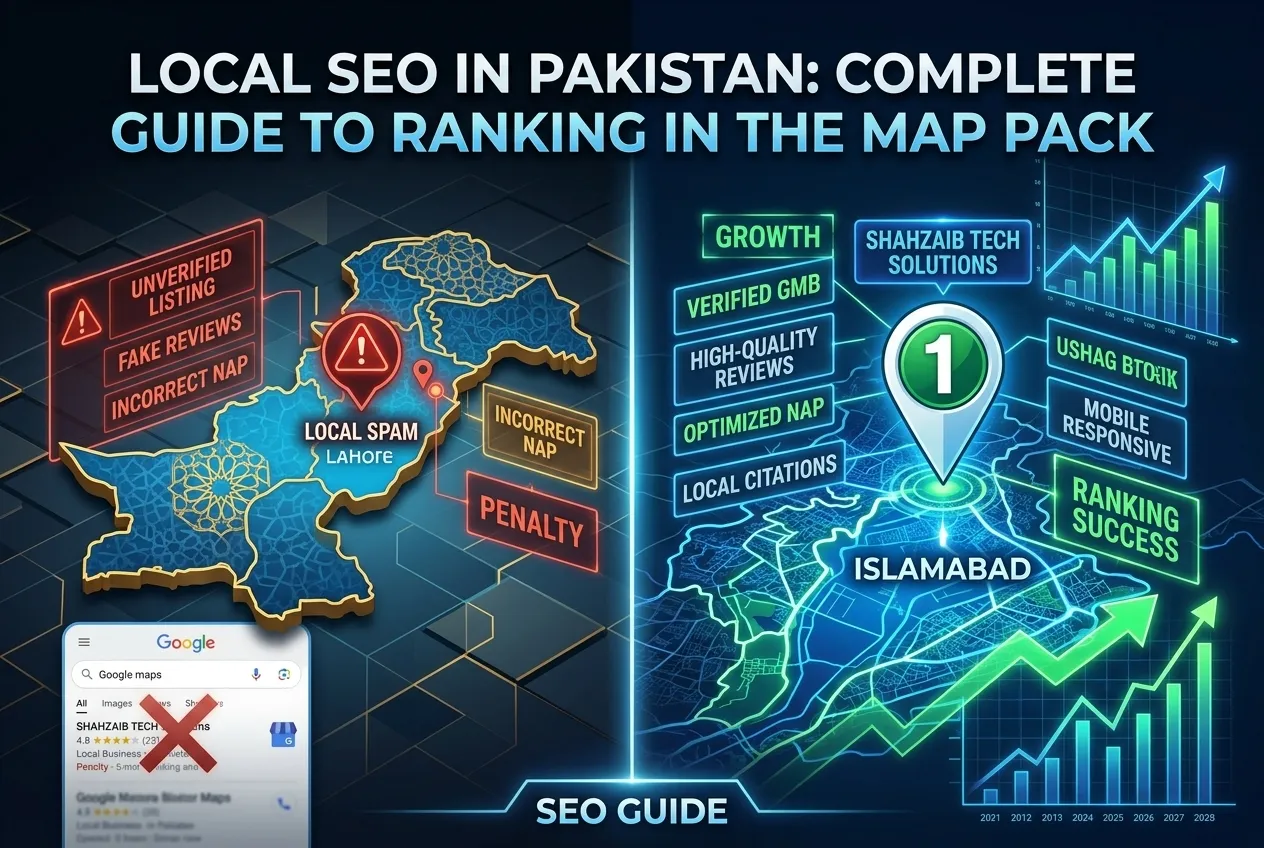
Local SEO in Pakistan: Complete Guide to Ranking in the Map Pack
What is local SEO? Local SEO is the process of optimizing a business’s online presence — primarily its Google Business Profile (GBP), website, citations, and reviews — so it appears in Google’s local pack (map pack), Google Maps, and localized organic results when someone nearby searches for that product or service. For a business in Lahore, Karachi, Islamabad, or any other Pakistani city, ranking in the map pack is often more valuable than ranking on page one of standard organic results, because map pack listings sit at the very top of the page, come with a map, reviews, and a call button, and capture the customer at the exact moment they are ready to buy.
This guide explains exactly how the map pack algorithm works in 2026, what has changed, and the specific steps a business in Pakistan needs to take to compete for the three coveted map pack positions — using current data from Google, Whitespark, BrightLocal, and Pakistan’s own telecom regulator.
| Local SEO in Pakistan — the numbers that matter • 117 million people were using the internet in Pakistan by late 2025, a 45.6% penetration rate, with 194 million active mobile connections (75.9% of the population). • Nationally, individual internet usage rose from 17% in 2019 to 57% in 2025, and mobile/smartphone ownership rose from 45% to 50% over the same period (PTA household survey). • The Google local pack (the 3-result map block) receives roughly 42–44% of all clicks on a local search results page — more than the organic listings below it. • Google Business Profile signals control roughly 32% of map pack ranking weight — the single largest ranking factor category, ahead of on-page signals (19%), reviews (16%), links (15%), behavior (8%), and citations (7%). • Proximity to the searcher alone is estimated to drive over half of map pack ranking outcomes, which is why the same business can rank #1 in one neighborhood and be invisible three kilometers away. |
What Is the Map Pack, and Why Does It Matter for Pakistani Businesses?
The map pack (also called the local pack or local 3-pack) is the block of three business listings, each paired with a small Google Map, star rating, address, and phone number, that appears near the top of Google Search for queries with local intent — think “dentist in Gulberg,” “best restaurant DHA Karachi,” or “packers and movers Islamabad.” Below the map pack sit the standard blue organic links.
Roughly 46% of all Google searches carry local intent, and because the map pack sits above the fold, it absorbs the largest share of clicks on that page. A business can rank on page one organically and still be completely absent from the map pack — the two systems use overlapping but distinct ranking signals. For a Pakistani small or medium business competing against dozens of similarly priced competitors in the same city, the map pack is frequently the highest-return piece of digital real estate available, because it converts browsers into phone calls and walk-ins rather than just website visits.
How the Google Local Pack Algorithm Actually Works
Google’s local ranking system is built on three foundational pillars, first defined by Google itself and confirmed every year by independent industry research: relevance, distance (proximity), and prominence. A listing needs to satisfy all three to compete, not just one.
- Relevance — how well a Google Business Profile matches what the searcher typed, based on the business category, name, description, services listed, and the content on the linked website.
- Distance — how close the business is to the location implied in the search, or to the searcher’s physical location on mobile. This is the factor businesses cannot fully control, and current research puts its influence at over 50% of the ranking decision inside the map pack.
- Prominence — how well-known and well-reviewed the business is, both online and offline — review volume and quality, citation consistency, backlink profile, and general brand visibility across the web.
Underneath these three pillars, industry-wide surveys of local search practitioners (Whitespark’s annual Local Search Ranking Factors study, cross-referenced with BrightLocal data) break the controllable ranking weight down as follows:
| Ranking factor group | Approx. weight in Map Pack | What it covers |
| Google Business Profile signals | 32% | Primary category, keywords in the business name, completeness of the profile |
| On-page signals | 19% | NAP consistency, local keywords, domain authority of the website |
| Review signals | 16% | Review quantity, velocity, diversity, and sentiment |
| Link signals | 15% | Inbound links, particularly from locally relevant domains |
| Behavioral signals | 8% | Click-through rate, calls, direction requests, engagement with the listing |
| Citation signals | 7% | Consistency of business listings across directories |
| Personalization | 3% | The searcher’s own history and location settings |
Weightings reflect expert consensus from industry-wide local search ranking factor surveys and should be treated as directional priorities rather than an exact Google algorithm formula.
Step-by-Step: How to Rank in the Map Pack in Pakistan
1. Fully Optimize Your Google Business Profile
Since GBP signals carry the heaviest weight in the map pack, this is where the work must start. For a Pakistani business, that means:
- Claim and verify the listing through Google’s verification process (phone, postcard, or video verification is common in Pakistan).
- Choose the most specific primary category available (e.g., “Orthodontist” rather than just “Dentist,” or “Real estate agency” rather than “Business”).
- Keep NAP data — Name, Address, Phone number — 100% consistent between the GBP listing, the website, and every directory listing.
- Add real photos of the storefront, staff, and work; profiles with photos consistently receive more direction requests and calls than those without.
- Use Google Posts and the Q&A section to keep the profile active, since posting frequency feeds into behavioral and freshness signals.
- List service areas correctly if the business serves multiple neighborhoods or cities (for example, a Lahore-based service business that also covers Gujranwala and Sialkot) rather than stuffing the business name with location keywords, which violates Google’s guidelines and risks suspension.
2. Build Consistent Local Citations
A citation is any online mention of a business’s NAP details, whether or not it links back to the website — think Google Maps, Facebook, PakWheels (for automotive), Daraz seller pages, JustDial, or Yellow Pages Pakistan. Inconsistent citations (a different phone number on one directory, an abbreviated address on another) actively confuse Google’s confidence in the business’s true location and can suppress map pack rankings even when everything else is strong.
- Audit every existing listing for exact NAP consistency, including punctuation and abbreviations.
- Build new citations on high-authority general directories first, then add Pakistan-specific and industry-specific directories.
- Update citations immediately after any change of address, phone number, or business name.
3. Earn and Respond to Reviews — Consistently, Not in Bursts
Reviews now function as both a ranking signal and the primary trust signal for a new customer: roughly 87% of consumers read online reviews before choosing a local business in 2026. What matters increasingly is not the total review count on its own but review velocity — a steady stream of two or three new reviews every month outperforms a single burst of twenty reviews followed by a year of silence, because Google reads ongoing review activity as a sign the business is genuinely active and serving customers.
- Ask every satisfied customer for a review at the natural end of the service, via WhatsApp link or SMS — the two most-used channels in Pakistan.
- Reply to every review, positive or negative, since responses themselves are a visible prominence and trust signal.
- Never buy fake reviews or incentivize them directly; both violate Google’s policies and can trigger a profile suspension.
4. Build City-Specific and Service-Specific Landing Pages
A business operating in more than one Pakistani city — for example Lahore, Karachi, Islamabad, and Rawalpindi — needs a unique, genuinely localized page for each city rather than one generic page with the city name swapped in. Each page should reference real neighborhoods (Gulberg, DHA, Johar Town, Blue Area, Clifton, Saddar), include embedded maps, local contact details, and, where possible, city-specific testimonials or case studies. Thin, duplicated location pages are one of the most common reasons Pakistani businesses fail to rank across multiple cities even after ranking well in their home city.
5. Get the Technical Foundation Right
Local ranking factors sit on top of a technical base that still has to function correctly. This includes LocalBusiness schema markup with accurate structured data (name, address, geo-coordinates, opening hours), fast mobile page speed given that the overwhelming majority of local searches in Pakistan happen on mobile devices, HTTPS, and a mobile-first responsive design. A Google Business Profile can be flawless and still underperform if the linked website is slow, unsecured, or not properly marked up — this is where a technical SEO review typically finds the most overlooked wins.
6. Build Local, Relevant Backlinks
Link signals still account for a meaningful share of map pack ranking weight. For a Pakistani business, the highest-value links tend to come from local news coverage, sponsorships of community or sports events, partnerships with complementary local businesses, and mentions on trade or industry association sites — a single link from a relevant local source is generally worth more than dozens of generic, low-quality directory links.
Local SEO vs. Regular (Organic) SEO — What’s the Difference?
The two disciplines overlap but are not identical. Regular organic SEO focuses on ranking a website in the standard blue-link results for any searcher, anywhere. Local SEO focuses specifically on ranking a physical location or service-area business in the map pack and localized organic results for searchers in a defined geographic area. A national e-commerce brand in Pakistan needs organic SEO; a dentist, restaurant, salon, real estate agent, or home-service business needs local SEO first, and organic SEO as a supporting layer.
Is Local SEO Still Worth It in 2026?
Search behavior is diversifying — AI-powered answers and assistants are increasingly cited for local recommendations alongside traditional Google search, and Google Business Profile signals carry somewhat less weight in AI-driven results than in the classic map pack. But the map pack itself remains a heavily used, high-converting feature of everyday Google search, and Google Business Profile optimization, consistent citations, and a real review pipeline remain the foundation that both classic and AI-era local visibility are built on. For Pakistani businesses, where mobile-first, “near me” search behavior is the dominant pattern, investing in the fundamentals covered above is not optional — it is the difference between being the business a customer calls in the next five minutes, or the one they never see.
| Ready to Actually Rank in the Map Pack? At Humza Zahid, our technical SEO team audits your Google Business Profile, citations, on-page setup, and site speed against the exact ranking factors covered in this guide, then builds and executes a 30/60/90-day local SEO roadmap built for your city and industry — transparent reporting, no long-term contract, PKR or USD billing. → Get a free local SEO audit for your business at /seo-services/local-seo/ |
Frequently Asked Questions
How long does local SEO take to show results in Pakistan?
Most businesses see initial movement in Google Business Profile visibility within 4 to 8 weeks of a proper optimization pass, with more durable map pack ranking gains typically building over 3 to 6 months as citations, reviews, and on-page signals accumulate. Highly competitive categories in Lahore or Karachi can take longer.
Do I need a physical office to rank in the map pack?
Not necessarily. Service-area businesses (electricians, home cleaners, movers) can use Google Business Profile’s service-area setting without displaying a public address, though a verifiable address still strengthens prominence and trust signals where one exists.
How much does local SEO cost in Pakistan?
Pricing varies by city, competitiveness, and scope, typically running as a monthly retainer rather than a one-time fee, since citations, reviews, and content need continuous upkeep. A transparent local SEO provider will scope this against your specific city and category rather than quoting a flat, generic number.
Can I do local SEO myself, or do I need an agency?
The fundamentals — claiming your Google Business Profile, requesting reviews, keeping NAP consistent — are accessible to any business owner. Technical elements like schema markup, site speed optimization, and citation audits at scale benefit from specialist expertise, particularly once a business is competing across more than one city.