Get In Touch
- Phone 01626479559
- Email hi.revox@gmail.com
- Address Based on honululu city, USA
- Follow us


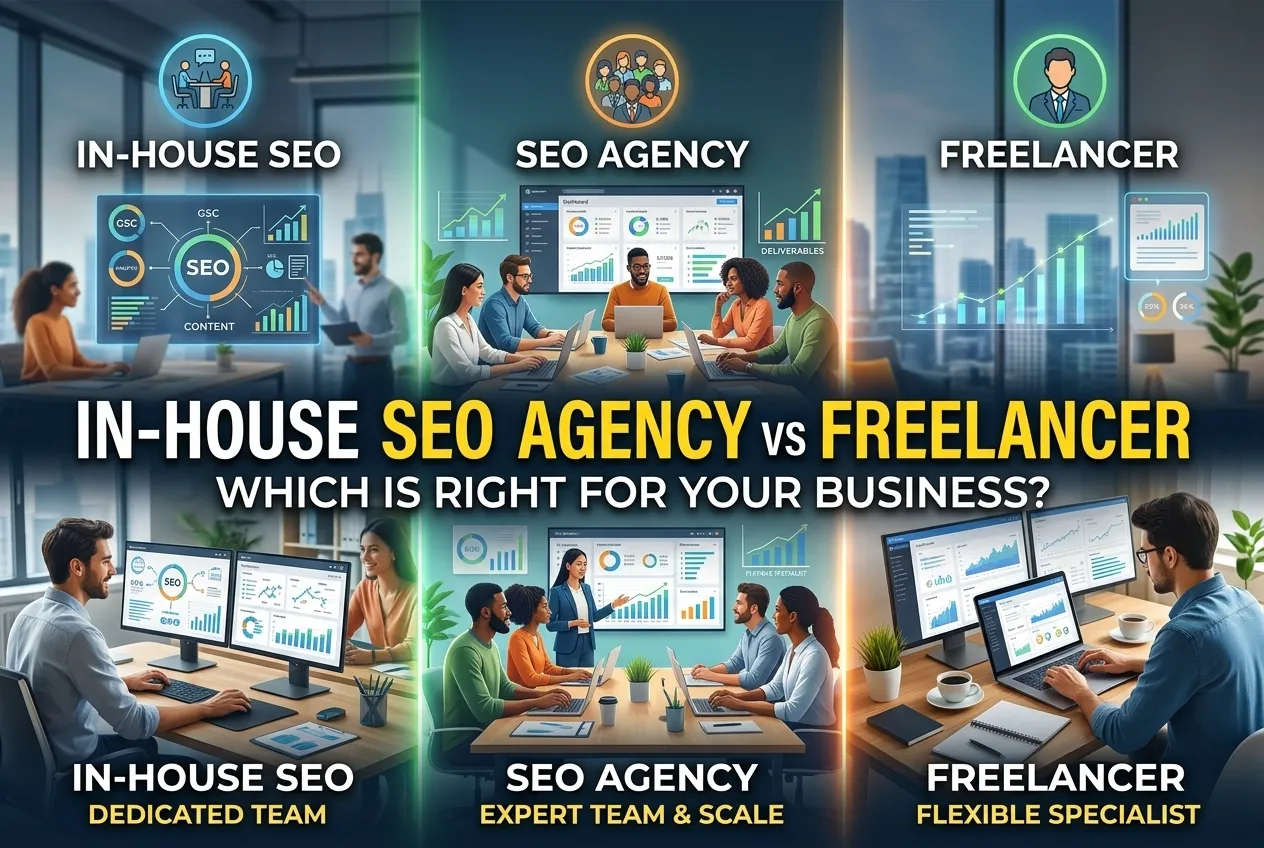
In-House SEO vs SEO Agency vs Freelancer: Which Is Right for Your Business?
Choosing how to run search engine optimization is one of the biggest decisions a business makes when it invests in organic growth. The three main options are building an in-house SEO team, hiring an SEO agency, or working with a freelance SEO consultant. Each model can deliver higher rankings, more organic traffic and qualified leads. But they differ sharply in cost, control, speed, expertise and scalability.
The wrong choice wastes budget and months of momentum. The right one compounds: better technical health, stronger topical authority, more relevant backlinks and steady growth in organic visibility.
Quick answer: choose a freelancer for budget-friendly, hands-on expertise; an agency for multi-channel scale and broad specialist skills; and an in-house team when SEO is a core, long-term revenue driver and you can afford dedicated headcount. Many mature brands combine two of them.
This guide breaks down each option, compares them side by side, and helps you decide with confidence.
What Is In-House SEO?
In-house SEO means employing full-time SEO professionals inside your company. These specialists, such as an SEO manager, technical SEO specialist or content strategist, work only on your website and report to your leadership.
Core entities and attributes of an in-house SEO team
- Roles: SEO manager, technical SEO specialist, content strategist, link builder, data analyst
- Ownership: full control of strategy, roadmap and priorities
- Tools: Google Search Console, Google Analytics 4, Semrush, Ahrefs, Screaming Frog
- Integration: works directly with developers, product, content and sales teams
Advantages of in-house SEO
- Deep brand and product knowledge. Your team understands your customers, tone, offers and industry nuances better than any outsider.
- Speed of internal collaboration. Fixes, content updates and technical changes move faster when SEO sits beside development and marketing.
- Full strategic control. Priorities follow your business goals with no competing clients.
- Long-term knowledge retention. Learnings, data and processes stay inside the company.
Disadvantages of in-house SEO
- High fixed cost. Salaries, benefits, recruitment and premium SEO tool licences add up quickly.
- Limited skill range. One or two hires rarely cover technical SEO, content, digital PR, analytics and schema markup at expert level.
- Slow to build. Hiring and onboarding can take months before results begin.
- Talent risk. If a key hire leaves, momentum and institutional knowledge go with them.
- Echo-chamber risk. Teams working on one site can miss trends, tactics and algorithm shifts seen across many industries.
What Is an SEO Agency?
An SEO agency is a specialist company that provides search engine optimization services to multiple clients. It typically assigns an account manager and a team covering technical SEO, on-page optimization, content marketing, link building and reporting.
Core entities and attributes of an SEO agency
- Team structure: account manager, strategist, technical SEO, content writers, outreach specialists, analysts
- Engagement model: monthly retainer, fixed-scope project or performance-linked contract
- Deliverables: SEO audits, keyword research, content plans, backlink acquisition, monthly reporting
- Scalability: resources can expand across many pages, markets or languages
Advantages of an SEO agency
- Broad expertise under one roof. Technical, content, links and analytics specialists work together.
- Proven processes and tooling. Agencies bring established frameworks, enterprise tool stacks and benchmarks from many clients.
- Scalability. It is easier to ramp up content, outreach or technical work when a campaign demands it.
- Cross-industry insight. Exposure to many sites helps agencies spot algorithm patterns early.
Disadvantages of an SEO agency
- Higher cost. Retainers often exceed freelance rates because they cover overhead and team layers.
- Shared attention. Your account competes for time with other clients.
- Communication layers. Account managers can sit between you and the person doing the work.
- Contract lock-in. Long minimum terms can be hard to exit if results disappoint.
- Variable quality. Work may be delegated to junior staff after the sales pitch.
What Is a Freelance SEO Consultant?
A freelance SEO consultant is an independent professional who provides SEO services directly to businesses without an agency structure. Many freelancers specialize in areas such as technical SEO, local SEO, e-commerce SEO or content optimization.
Core entities and attributes of a freelance SEO consultant
- Structure: solo expert, sometimes with a small trusted network of writers or developers
- Engagement model: hourly rate, fixed-price project or monthly retainer
- Typical services: SEO audits, keyword research, on-page optimization, technical fixes, link building and reporting
- Communication: direct access to the person doing the work
Advantages of a freelance SEO consultant
- Cost efficiency. Lower overhead usually means better value, especially for small and mid-sized businesses.
- Direct communication. You talk to the strategist and the implementer, with no account manager in between.
- Flexibility. You can scale engagement up or down, or hire for a single project such as an audit or migration.
- Fast start. No lengthy hiring process, so work can begin within days.
- Specialist depth. A seasoned freelancer often brings agency-level experience with more personal accountability.
Disadvantages of a freelance SEO consultant
- Capacity limits. One person can only handle so much work at once.
- Skill gaps. Few individuals are equally strong in technical SEO, content, digital PR and analytics.
- Availability risk. Illness, holidays or a full client roster can slow delivery.
- Vetting effort. Quality varies widely, so you need to screen carefully.
In-House SEO vs SEO Agency vs Freelancer: Side-by-Side Comparison
Use this table to compare the three models across the factors that matter most when choosing an SEO partner.
| Factor | In-House SEO | SEO Agency | Freelance SEO |
| Typical cost model | Salary + benefits + tools + training | Monthly retainer or project fee | Hourly rate, fixed project, or small retainer |
| Cost level | Highest fixed cost | Mid to high | Lowest to mid |
| Control over strategy | Full | Shared | High |
| Brand and product knowledge | Deepest | Moderate, builds over time | Moderate to high, depends on the individual |
| Breadth of skills | Limited to the team hired | Broad, specialist teams | Narrower, often a strong generalist |
| Speed to start | Slow (hiring and onboarding) | Fast to moderate | Fastest |
| Scalability | Slow, needs headcount | High | Limited by one person’s capacity |
| Communication | Immediate, internal | Account manager layer | Direct with the expert |
| Best for | Large, mature, SEO-critical brands | Mid-size to enterprise, multi-channel growth | Startups, SMEs, and focused projects |
How Much Does Each SEO Option Really Cost?
Price is rarely just the headline number. Each model has direct costs and hidden costs, and comparing both gives a truer picture of total investment.
| Model | Where the money goes | Hidden costs to budget for |
| In-house SEO | Salary, benefits, recruitment, SEO tools, training | Turnover risk, downtime, tool licences, management time |
| SEO agency | Retainer covering strategy, content, links and reporting | Add-on fees, long contracts, onboarding time, reporting layers |
| Freelance SEO | Hourly, project or monthly fees | Your own time briefing and managing, plus extra tools or writers if needed |
A note on numbers: rates vary widely by country, seniority, industry and scope, so always request written quotes and compare them against deliverables rather than headline price. Cheap SEO that relies on low-quality links or thin content can damage rankings and cost far more to fix later.
Remember also that SEO is a compounding investment. Results typically build over several months, so judge each option on the quality of strategy, transparency and reporting, not on how fast it promises page-one rankings.
How to Choose: In-House vs Agency vs Freelancer
There is no universal winner. The best SEO model depends on your budget, business stage, website complexity and internal capabilities. Work through these five questions.
1. What is your budget?
If budget is limited, a freelance SEO consultant usually delivers the best return per dollar. Agencies suit companies ready to invest a consistent monthly amount. In-house teams make sense when SEO justifies dedicated salaries.
2. How big and complex is your website?
A local service business with 30 pages has very different needs from an e-commerce store with 50,000 URLs. Large sites with faceted navigation, international targeting or heavy JavaScript often need deeper technical resources, which points to an agency, a senior freelancer or an in-house technical specialist.
3. How fast do you need to move?
Freelancers can start within days. Agencies typically onboard within a few weeks. Building an in-house team takes the longest because of recruitment and training.
4. How much control do you need?
If you want SEO tightly woven into product, engineering and brand decisions, in-house offers the most control. If you prefer expert guidance without managing staff, a freelancer or agency fits better.
5. Do you have internal SEO knowledge?
If nobody in your company understands SEO, an experienced freelancer or agency can lead and educate. If you already have a strong lead, you may only need extra capacity for content, links or technical work.
Quick Decision Guide
| If your situation is… | Your best fit is… |
| Startup or small business with a tight budget | Freelance SEO consultant |
| Need a one-off SEO audit, migration or fix | Freelance SEO consultant |
| Need content, links, technical and CRO at scale | SEO agency |
| SEO is a core revenue channel, large site, big budget | In-house team (often plus an agency) |
| Want strategy plus flexibility to scale up or down | Hybrid: in-house lead + freelancer or agency |
| Running an e-commerce store with thousands of URLs | Agency or senior freelancer with technical depth |
The Hybrid SEO Model: Combining Approaches
You do not have to choose only one. Many high-performing businesses blend models to balance cost, control and expertise.
- In-house lead + freelancers. A strategic SEO manager sets direction while freelancers handle audits, content or link building.
- In-house team + agency. Internal staff own strategy and reporting; the agency delivers scalable execution such as outreach or large content programs.
- Agency + freelancer specialist. An agency handles general SEO while a freelancer covers a niche such as technical audits or schema implementation.
A hybrid setup works best when roles are clearly defined, reporting is shared and everyone works to the same KPIs.
Red Flags When Hiring an SEO Freelancer or Agency
Whichever option you choose, watch for these warning signs.
- Guaranteed rankings. No one controls Google’s algorithm. Promises of guaranteed position one are a red flag.
- No transparency. Vague answers about tactics, links or reporting often hide poor practice.
- Spammy link building. Private blog networks and bulk directory links can trigger penalties.
- No case studies or references. Reputable providers can explain past work and share verifiable results.
- One-size-fits-all packages. Good SEO starts with an audit of your goals, market and site, not a generic checklist.
- Reporting on vanity metrics only. Look for progress in qualified traffic, leads and revenue, not just impressions or rankings for irrelevant terms.
Questions to Ask Before You Hire
- Which industries and website types have you worked with?
- How do you approach keyword research and search intent?
- What does your reporting include, and how often will I receive it?
- How do you build links, and what do you avoid?
- Who exactly will work on my account?
- How do you handle Google algorithm updates?
- What are the contract terms, and how can I exit?
Which Option Delivers Better SEO Results?
Results depend far more on strategy, execution quality and consistency than on the model itself. A skilled freelancer can outperform a mediocre agency, and a strong agency can outperform an under-resourced in-house team.
Whichever route you take, judge success against these measurable outcomes:
- Growth in organic traffic and qualified organic sessions
- Improved keyword rankings for commercially relevant terms
- Higher organic conversion rate, leads and revenue
- Better Core Web Vitals and technical health
- Growth in topical authority and quality backlinks
- Stronger visibility in featured snippets, AI Overviews and other SERP features
Final Verdict: Which SEO Model Should You Choose?
The right SEO setup is the one that matches your goals, budget and stage of growth.
- Choose a freelance SEO consultant if you want expert, hands-on work at a sensible price with direct communication and flexibility.
- Choose an SEO agency if you need broad skills, scalable execution and structured processes across many channels or markets.
- Choose in-house SEO if organic search is central to your revenue and you can support a dedicated team long term.
- Choose a hybrid if you want strategic ownership plus flexible, specialist support.
Whatever you pick, start with a clear goal, agree on measurable KPIs and insist on transparent reporting. SEO rewards patience and consistency, and the right partner will make your search visibility a lasting business asset.
Need Help Deciding? Let’s Talk SEO
If you are weighing your options and want an honest, data-led recommendation for your website, you can get in touch at humzazahid.com to discuss your goals, audit your current setup and map out the SEO approach that fits your business.
Frequently Asked Questions
Is it better to hire an SEO freelancer or an agency?
It depends on scope and budget. A freelancer is usually better for small to mid-sized businesses that want direct expert access at lower cost. An agency is better when you need a multi-skilled team and scalable execution across content, links and technical SEO.
Is in-house SEO worth it?
In-house SEO is worth it when organic search is a primary revenue channel and you can fund a dedicated team. It gives you the deepest brand knowledge and control, but it costs more and covers a narrower range of skills than a specialist agency.
How much does it cost to hire an SEO freelancer vs an agency?
Freelancers generally cost less because they carry lower overhead, while agencies charge more to cover team resources, management and tools. Exact pricing varies by market, experience and scope, so request written quotes and compare deliverables, not just price.
How long does SEO take to show results?
SEO typically takes several months to show meaningful results, and competitive markets can take longer. Timelines depend on your site’s current health, competition, content quality and link profile, regardless of which model you use.
Can I switch from an agency to a freelancer, or the other way round?
Yes. Businesses often change models as they grow. To make the switch smooth, keep ownership of your Google Search Console, Google Analytics and CMS access, and ask for documentation and reports before you part ways.
What is the best SEO option for a small business?
For most small businesses, a freelance SEO consultant offers the best balance of cost, expertise and flexibility. As the business grows, you can add an agency or an in-house hire.
Should I combine in-house SEO with an agency or freelancer?
Often, yes. A hybrid model lets an internal lead own strategy while external specialists handle scalable tasks such as content production, outreach or technical audits.