Get In Touch
- Phone 01626479559
- Email hi.revox@gmail.com
- Address Based on honululu city, USA
- Follow us

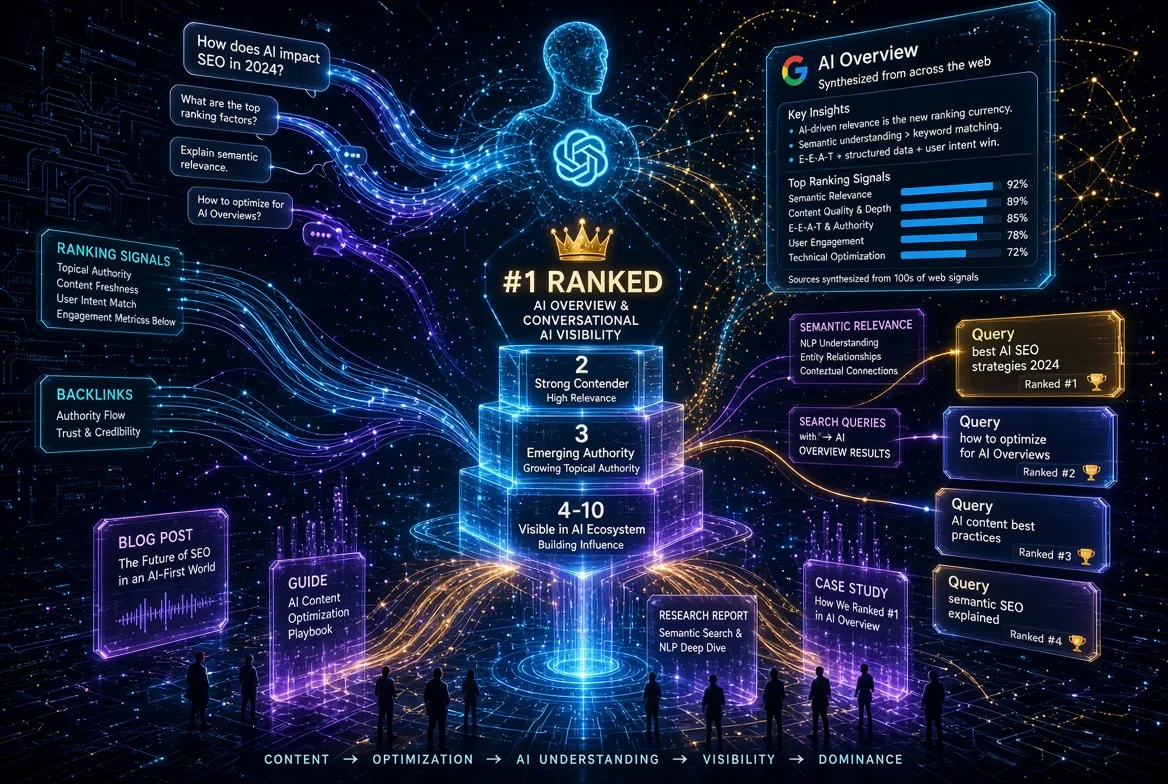
AI SEO: Ranking in AI Overviews and ChatGPT
Search has quietly split in two. There is still the ten blue links world, and then there is a newer world where Google writes the answer for the user before a single link gets clicked, and where hundreds of millions of people ask ChatGPT the question instead of opening a browser tab at all. If your SEO strategy has not caught up to that split, you are optimizing for a search engine that is shrinking while ignoring the one that is growing fastest.
This guide explains what AI SEO actually is, how AI Overviews and ChatGPT decide what to cite, and what a business needs to do differently to stay visible. We will walk through real numbers, not guesses, and include tables and checklists you can act on this week.
What Is AI SEO
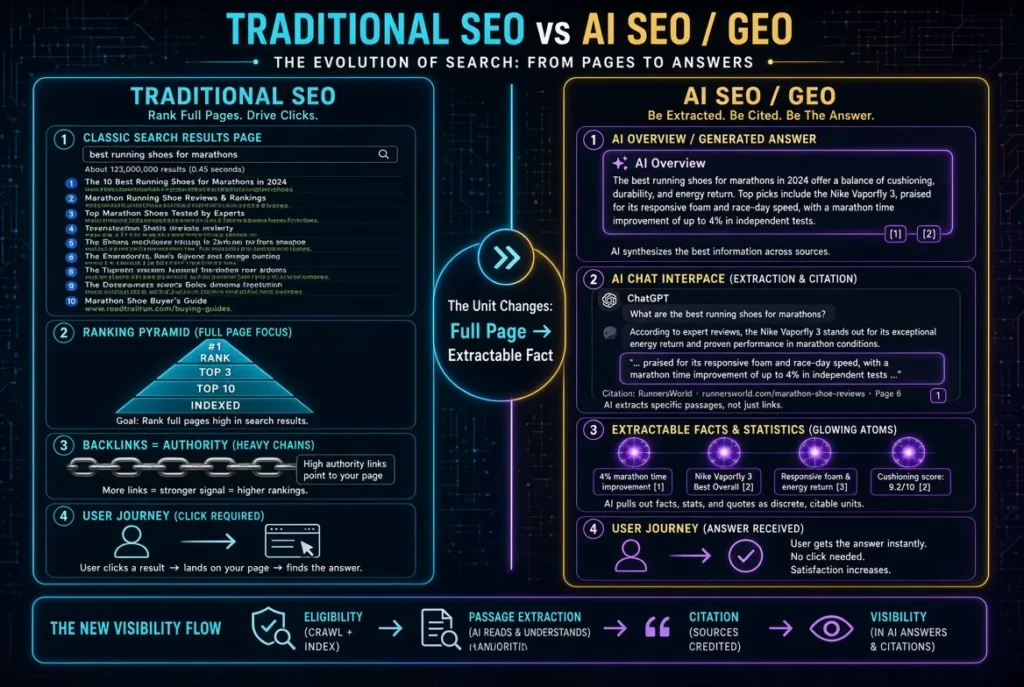
AI SEO, also called generative engine optimization or GEO, is the practice of structuring content so that AI systems such as Google’s AI Overviews, AI Mode, ChatGPT, Perplexity, and Microsoft Copilot are more likely to retrieve it, quote it, and cite it when answering a user’s question. It sits alongside traditional SEO rather than replacing it, because most AI systems still start with a search index before they generate an answer.
The core difference is the unit being optimized. Traditional SEO optimizes a page to rank in a list. AI SEO optimizes a passage, a statistic, or a clearly stated fact to be extracted and reused inside a synthesized answer. A page can rank on page one and still never get quoted by an AI Overview, and a page ranking on page two can get cited if it states a fact more clearly than the page above it.
AI SEO vs Traditional SEO vs GEO
| Factor | Traditional SEO | AI SEO / GEO |
|---|---|---|
| Goal | Rank in the top 10 blue links | Get retrieved and quoted inside a generated answer |
| Success metric | Position, organic clicks | Citation share, brand mentions, AI referral traffic |
| Content unit | The full page | The extractable passage or fact |
| Key signal | Backlinks, keyword relevance | Statistics, direct answers, structured facts, entity clarity |
| Where it shows up | Search engine results page | AI Overview box, AI Mode, ChatGPT, Perplexity, Copilot |
| Click behavior | User clicks to read more | User often gets the full answer without clicking |
The Numbers That Prove This Shift Is Real
The scale of this change is easy to underestimate until you see the data side by side.
Google’s AI Overviews had already reached roughly 2 billion monthly users by early 2026 according to industry estimates, and Google confirmed at its I/O developer conference in May 2026 that the feature had grown past 2.5 billion monthly active users, with AI Mode crossing 1 billion within a year of its own launch. Coverage of individual searches has grown just as fast. Data from BrightEdge, an enterprise SEO platform, put the share of tracked queries triggering an AI Overview at roughly 48 percent in early 2026, a jump of about 58 percent from the same point in the prior year. Google has expanded the feature to more than 200 countries and territories in over 40 languages.
ChatGPT’s growth has been just as steep. Analysis citing Search Engine Land found that 37 percent of consumers now say they start their searches with an AI tool rather than a traditional search engine, and that ChatGPT’s weekly active user base crossed 900 million, up from roughly 400 million only a year earlier. By some measurements that makes it the fourth most visited website in the world, pulling in more than 5 billion monthly visits.
The part that should worry every SEO manager is what happens to clicks once an AI answer appears. The Pew Research Center ran what is probably the most rigorous independent study on this question, tracking 900 US adults across nearly 69,000 real Google searches. It found that people clicked through to a traditional result only 8 percent of the time when an AI Overview was present, compared with 15 percent when no AI Overview appeared, a drop of roughly 47 percent. Separately, Seer Interactive’s analysis of more than 5 million tracked queries found that by December 2025 the presence of an AI Overview was associated with a 58 percent lower click through rate for the page ranking first.
There is a silver lining buried in that same research. Seer Interactive also found that brands actually cited inside an AI Overview earned about 120 percent more organic clicks per impression than brands that were not cited on the same queries. Being cited is no longer a nice bonus. On many queries it is close to becoming the only realistic way to get clicked at all.
Key AI Search Statistics at a Glance
| Metric | Figure | Source |
|---|---|---|
| Google AI Overviews monthly active users | Over 2.5 billion | Google, I/O 2026 announcement |
| Query share triggering an AI Overview | Around 48 percent, range 25 to 60 percent across studies | BrightEdge, Conductor, Semrush |
| ChatGPT weekly active users | Over 900 million | Search Engine Land, industry analysis |
| Consumers who now start searches with AI tools | 37 percent | Search Engine Land |
| Click rate drop on queries with an AI Overview present | 47 to 58 percent lower | Pew Research Center, Seer Interactive |
| Extra organic clicks per impression when cited in an AI Overview | About 120 percent more than uncited brands | Seer Interactive, 2026 |
| Google search referral traffic decline to publishers | About one third year over year | Press Gazette |
Trigger rates are not uniform across industries. One aggregated dataset pulling from BrightEdge and Semrush found healthcare queries carry an AI Overview roughly 88 percent of the time, while shopping and transactional queries sit much lower, around 13 to 14 percent. Question style and longer queries trigger AI Overviews far more often than short, one or two word searches. That distinction matters for an SEO business specifically, since searches like “what is seo” or “how does seo work” are exactly the long, informational query type that AI Overviews now dominate.
How Google’s AI Overviews Actually Choose What to Show
AI Overviews are not a separate crawl of the internet. They are generated using a customized version of Google’s Gemini model, layered on top of the same search index that produces the standard results page. In practical terms this means the old fundamentals, crawlability, indexing, page experience, and topical relevance, still decide whether your page is even eligible to be pulled into an answer. What changes is what happens after that point.
Once a page is eligible, Google’s system extracts specific passages rather than judging the page as a single unit. That is why a well structured FAQ block, a clearly labeled definition, or a tight table of statistics can outperform a longer but less structured competitor, even one with a stronger backlink profile.
How ChatGPT Chooses Its Sources
ChatGPT’s citation behavior works differently enough from Google’s that it needs its own strategy. When a query triggers a live web search inside ChatGPT, the system uses a technique called retrieval augmented generation, or RAG. It breaks the question into sub queries, retrieves several live pages, ranks them by relevance and trust signals, and then writes an answer using a small set of those sources.
Three findings from recent research should shape how you approach this.
- Bing’s index matters more than most site owners assume. Several independent analyses report that ChatGPT’s live search layer draws primarily from Bing’s index rather than Google’s, which means a page that has never been submitted through Bing Webmaster Tools can be effectively invisible to ChatGPT’s real time citations regardless of how well it ranks on Google.
- A narrow set of trusted domains absorbs most citations. Research summarized by Search Engine Land found that roughly 30 domains account for around two thirds of ChatGPT citations within a given topic, meaning earned mentions on established, high trust publications carry outsized weight compared with owned content alone.
- Position on the page matters a great deal. One 2026 citation study found that more than 44 percent of ChatGPT citations were pulled from the first third of a page, with another 31 percent coming from the middle section, which means a direct answer buried under a long introduction is far less likely to be quoted.
Independent analysis of roughly 700,000 real ChatGPT conversations adds a further wrinkle. It found that a user’s opening question is about two and a half times more likely to trigger a citation than the tenth message in the same conversation, and nearly four times more likely than the twentieth. If you want your content cited, you need to win the first question in a person’s research journey, not a later clarifying follow up.
The source mix also skews heavily toward earned, independent coverage rather than brand owned pages. A large scale study analyzing more than 25 million links across ChatGPT, Claude, and Gemini answers found that third party sources account for about 84 percent of all citations, journalism alone makes up roughly 27 percent, and paid content accounts for barely 0.3 percent. A separate study of 75,000 brands found that mentions on YouTube correlated with AI visibility more strongly than any other signal tested, well ahead of backlinks or domain authority scores, though this is a correlation rather than proof that YouTube mentions directly cause citations.
Does Structured Data Actually Help AI Citations
This is one of the more contested questions in AI SEO right now, and it deserves an honest answer rather than a marketing one.
Several agencies report strong lifts from adding schema markup. One documented a jump of nearly 400 percent in SERP features and more than a tenfold increase in AI Overview appearances over three months after adding schema across its site, though the agency itself noted the effect looked indirect: schema improved traditional rankings first, and that stronger ranking made AI citation more likely as a side effect. Other write ups report gains ranging from roughly a third more AI summary appearances up to claims of two and a half times higher citation rates for pages carrying complete schema.
A more rigorous controlled study published on the SSRN research platform pushes back on the idea of a direct causal link. Researchers collected 730 AI citations from ChatGPT and Gemini across 75 commercial search queries and initially found a negative association between having schema and being cited, which they eventually traced to a confound: Google’s own ranking algorithm already tends to enrich top ranking pages with schema, which inflated how common schema looked among pages that were actually being cited for other reasons entirely. Ahrefs ran a similar controlled experiment on pages that were already receiving more than 100 AI citations a month, and found that adding JSON-LD schema to those pages produced no meaningful additional lift, concluding that the correlation between schema and AI citation likely reflects that both are markers of an already authoritative, well maintained site rather than schema causing the citation on its own.
One exception is worth noting. The SSRN study found that pages using Product or Review schema with populated, concrete fields, such as pricing and aggregate rating values, were cited at meaningfully higher rates than pages using generic Article or Organization schema, roughly 62 percent versus 42 percent, with the advantage most pronounced on lower authority domains.
The practical takeaway is to implement schema because it is good technical hygiene, improves rich results, and helps AI systems parse your page’s structure, not because it functions as a guaranteed citation shortcut on its own.
What the Research Says Actually Moves the Needle
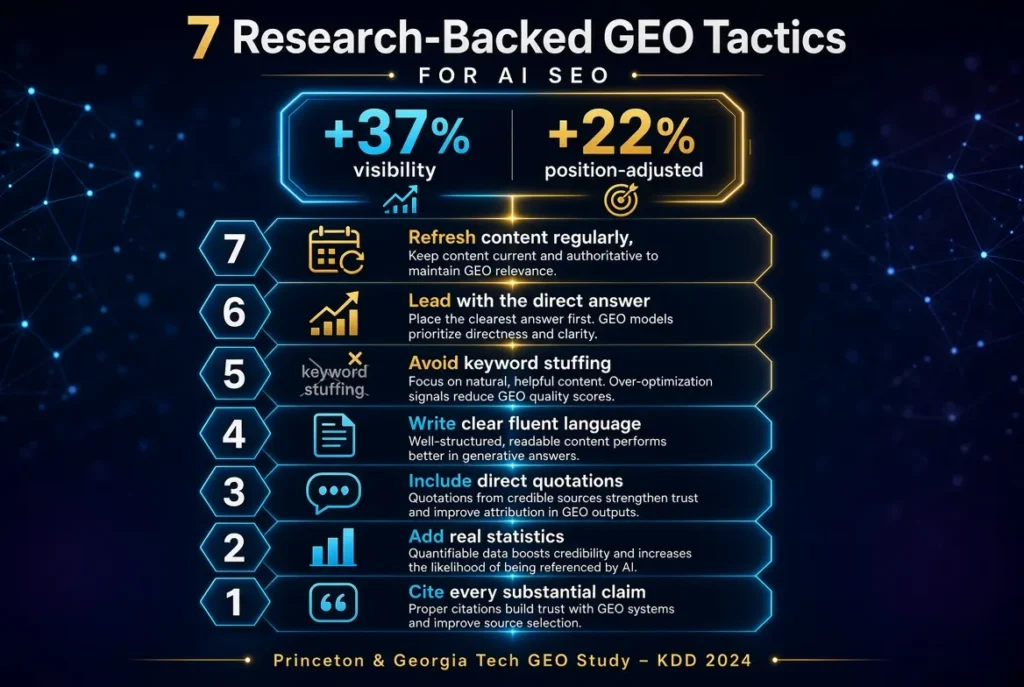
The most credible academic source in this field is a paper from researchers at Princeton University and Georgia Tech titled “GEO: Generative Engine Optimization,” presented at the KDD 2024 conference and still the most cited controlled study on this topic. The researchers ran roughly 10,000 queries across nine datasets spanning seven domains and tested nine distinct content optimization strategies against a simulated generative engine pipeline.
The results were validated a second time on Perplexity using 200 real queries, and the pattern held up. Adding direct quotations improved a position adjusted visibility metric by about 22 percent over baseline, and adding statistics improved a separate subjective quality metric by roughly 37 percent. The strongest results came from combining fluency improvements with added statistics, which beat any single strategy used alone. Crucially, the study found that keyword stuffing, the classic old school SEO tactic, actually performed about 10 percent worse than making no changes at all.
7 GEO Tactics Backed by the Research
- Cite every substantial claim. Attribute statistics and factual statements to a named, checkable source rather than stating them as unsupported opinion.
- Add real statistics, not vague qualifiers. Replace a phrase like “many businesses struggle with this” with a specific number and where it came from.
- Include direct quotations from credible experts or studies. Quotation addition was one of the two strongest individual methods the researchers tested.
- Write in clear, fluent, well organized language. Pairing fluency improvements with statistics was the single best performing combination in the study.
- Avoid keyword stuffing entirely. It measurably reduced visibility in generative engine answers, the opposite of what it once did for classic search rankings.
- Lead with the direct answer. Place the core fact or definition in the first third of the page, since that is where most extraction happens.
- Refresh content on a regular cadence. Recency is a recurring signal across independent studies of what generative engines prefer to surface.
A Practical AI SEO Checklist
Use this list when auditing or building a page for AI visibility.
- Structure the first 100 to 150 words as a direct, extractable answer to the page’s core question.
- Add a dedicated FAQ section using FAQPage schema, keeping each answer to roughly 40 to 60 words.
- Back every meaningful claim with a specific statistic and a named, credible source.
- Name the real entities relevant to your topic: tools, platforms, methodologies, locations, and recognized terminology, rather than vague description.
- Claim and actively maintain your Bing Webmaster Tools listing, since ChatGPT’s live retrieval depends heavily on Bing’s index.
- Pursue earned coverage on independent, high trust publications rather than relying only on owned content, since third party sources dominate AI citations.
- Keep content fresh with a two to three month review cycle instead of publishing once and leaving it static.
- Track AI referral traffic separately inside GA4 and monitor citation appearances with a dedicated AI visibility tool, since this channel behaves differently from organic search and needs its own reporting.
Frequently Asked Questions
Is AI SEO the same thing as GEO? Largely yes. Generative engine optimization is the formal academic and industry term, while AI SEO is the more common shorthand used in everyday marketing conversation. Both describe the same practice: optimizing content to be retrieved and cited inside AI generated answers.
Does ranking well on Google guarantee an AI Overview citation? No. AI Overviews pull from Google’s existing search index, so ranking well improves eligibility, but the system extracts individual passages rather than rewarding the page as a whole. A page ranking lower on the results page can still be cited if it states a fact more clearly than the page above it.
Is traditional SEO dead because of AI Overviews and ChatGPT? No. Every credible study on this topic still shows AI systems building on top of an existing search index, whether Google’s or Bing’s. Technical SEO, clean site structure, and genuine topical authority remain the foundation that AI visibility is built on top of, not something AI has replaced.
AI Overviews and ChatGPT are not a passing trend to wait out. Between them they already reach billions of users, and they are actively reshaping click behavior across nearly every informational search. The businesses treating AI SEO as a structured discipline, backed by real data rather than guesswork, are the ones earning that roughly 120 percent click premium that comes with being the source an AI system trusts enough to name.